
Everyone Is Exhausted.
And It's Not Because They Need More Sleep.

Everyone Is Exhausted. And It’s Not Because They Need More Sleep.
Nervous system burnout has quietly become one of the biggest health issues of our time. Your clients are living it. And if you work in wellness, you’re sitting on one of the most needed skill sets in the market right now.
Something is happening to people and most of them don’t have a name for it.
They’re not sick exactly. They’re not lazy. They’re sleeping eight hours and waking up tired. They’re taking vacations and coming home more depleted than when they left. They’re doing “all the right things” and still feeling like they’re running on empty, one minor inconvenience away from completely losing it.
Sound familiar? You’ve probably heard some version of this from your clients. You might be living some version of it yourself.
What they’re describing isn’t a motivation problem or a time management problem. It’s a nervous system problem. And it’s everywhere right now.
What’s actually going on
Your nervous system is your body’s command center. It decides when you’re safe, when you’re threatened, when to rest, when to fight. For most of human history it was pretty good at its job — a real threat would show up, your body would respond, the threat would pass, and you’d recover.
The problem is that our nervous systems were not built for the world we’re living in now.
Constant notifications. A news cycle that never stops. Financial pressure. The pressure to be productive, present, connected, and optimized all at the same time. None of these are life-or-death threats, but your nervous system doesn’t know that. It responds to a scary email the same way it would respond to a predator. And when that happens dozens of times a day, every day, for years — it never gets to fully switch off.
The result is a body stuck in a permanent low-grade state of alert. Not quite in crisis, but never fully at rest either. And over time, that wears everything down — sleep, digestion, mood, focus, immunity, relationships. All of it.
This is nervous system exhaustion. And it’s not a fringe concept anymore. Researchers, doctors, and mental health professionals are all saying the same thing: we are living through a nervous system crisis, and it’s getting worse.
Why this matters for your practice right now
Here’s the business reality underneath all of this.
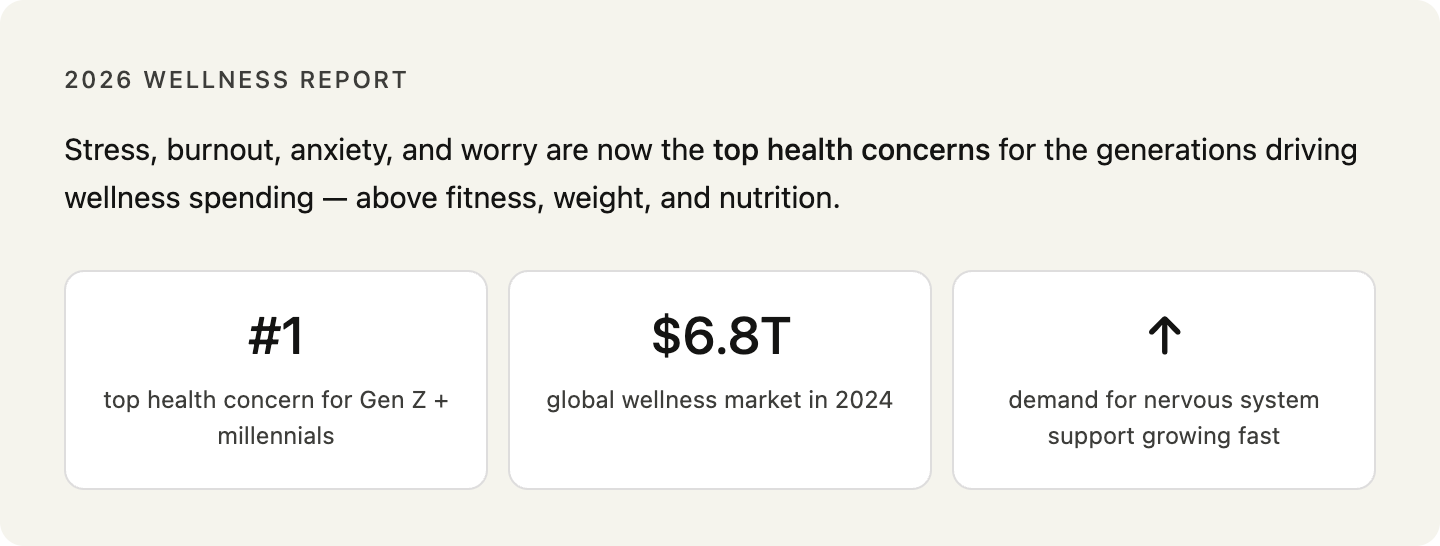
The generations driving wellness spending right now — millennials and Gen Z — are reporting stress, burnout, anxiety, and worry as their top health concerns. Not weight loss. Not fitness goals. Nervous system stuff. And they are actively spending money to address it.
They’re looking for practitioners who understand what’s happening in their bodies. Who can explain it without judgment. Who have real tools — not just “try meditating” or “cut back on caffeine” — to help them actually regulate and recover.
If you’re a therapist, a somatic practitioner, a coach, a breathwork facilitator, an acupuncturist, a yoga teacher, a counselor — you already have those tools. You may have been using them for years without calling them “nervous system work.”
But here’s the thing: the language matters.
When clients can see themselves in what you do — when they read the words “nervous system exhaustion” and think that’s exactly what I’ve been trying to describe — they don’t need to be convinced to work with you. They’re already sold. They just needed to find you.
What your clients are actually searching for
People don’t Google “I need a somatic practitioner.” They Google “why am I so tired all the time” and “why do I feel anxious for no reason” and “how to stop feeling burnt out” and “why can’t I relax even when nothing is wrong.”
They’re describing their symptoms in plain language because that’s all they have. They don’t know what’s causing it. They just know something feels off and they can’t shake it.
Your job — not just in the treatment room but in how you talk about your work publicly — is to meet them where they are. To use the language they’re already using. To show them that what they’re experiencing has a name, that it makes complete sense given what their bodies have been through, and that there’s a real path through it.
That’s not marketing. That’s just being findable to the people who need you most.
The three things clients with nervous system exhaustion actually need
Understanding this helps you serve them better — and helps you explain your work more clearly to people who haven’t found you yet.
They need to feel safe first. A dysregulated nervous system is a defensive one. Before a client can do any real healing work they need to feel genuinely safe in the room with you — not rushed, not judged, not pushed faster than their body is ready to go. The pacing of your sessions matters enormously for this population.
They need education, not just treatment. Most people with nervous system exhaustion have spent years being told they’re fine, they just need to relax, or it’s all in their head. Explaining what’s actually happening in their body — in plain, simple terms — is often one of the most healing things a practitioner can offer. It gives people their experience back. It says: this is real, it makes sense, and it’s not your fault.
They need consistency over intensity. This is important to communicate upfront. Nervous system recovery isn’t a one-session fix. It’s not a retreat or a cleanse. It’s slow, steady, repeated signals to the body that it’s okay to come down from high alert. Clients who understand this from the start are more likely to commit to the ongoing work — which is better for them and better for your practice.
How to position yourself in this space
You don’t need a new certification to speak to this. You need to get clear on how your existing work addresses it — and then say that clearly.
A few practical things that make a real difference:
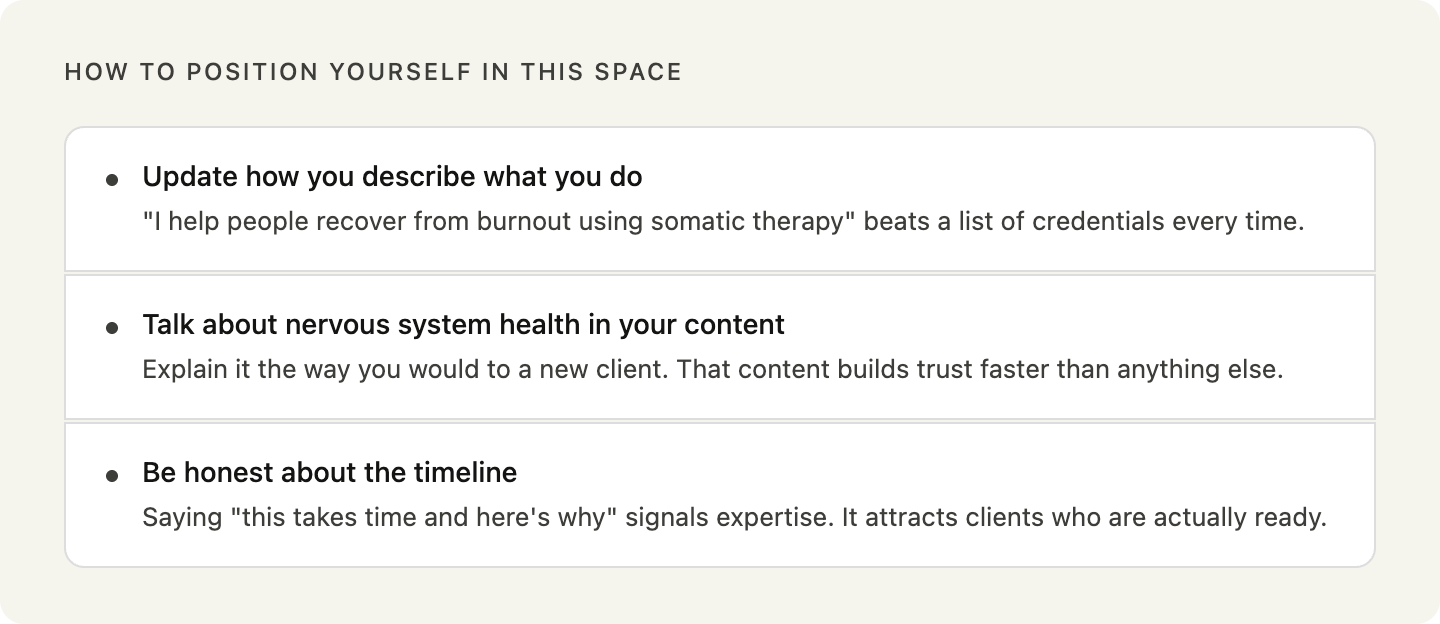
Update how you describe what you do. If your website or bio talks about your modality but not the problem it solves, you’re making people work too hard to find you. “I help people recover from burnout and chronic stress using somatic therapy” is more searchable, more relatable, and more immediately useful to someone in pain than a description of your credentials and techniques.
Talk about nervous system health in your content. Not in a clinical, overwhelming way — just the way you’d explain it to a client in their first session. What is it? Why is it so common right now? What does recovery actually look like? This kind of content builds trust fast because it shows you understand what people are going through before they’ve ever met you.
Be honest about the timeline. In a world full of quick fixes and overnight transformations, a practitioner who says “this takes time and here’s why” stands out. It signals expertise. It sets realistic expectations. And it attracts the clients who are actually ready to do the work — which makes your job more fulfilling and your results stronger.
The bigger opportunity
Nervous system exhaustion isn’t going away. If anything, the pace of modern life is accelerating. The practitioners who build real expertise in this space — who can speak to it clearly, who have a genuine process for working with it, and who show up consistently for the people who need it — are going to be in very high demand for a long time.
This is one of those moments where what’s trending in the broader culture and what you’ve spent years training to do are pointing at exactly the same thing.
The clients are out there. They’re exhausted, they’re searching, and they’re ready to find someone who actually gets it.
That someone is you. The question is just whether they can find you.
If you’re thinking about how to grow your practice this year — not just serve more clients but build something more financially stable and sustainable — our free Grants Guide is worth a look. It covers what funding is actually available for wellness businesses like yours, how to position yourself to get it, and how to make it part of your growth plan going forward.
Because the work you’re doing matters. And you deserve to be well-resourced doing it.
This resonated with me.
One thing I have observed over the years is that people often assume exhaustion means they need more rest, when sometimes what they really need is relief from a system that has come to interpret too many ordinary experiences as threats, like a difficult conversation, an unanswered text, a financial uncertainty, a physical symptom, a mistake.
None of these is life-threatening, yet they can keep the body behaving as though danger is constantly nearby.
What makes it especially challenging is that this state can become so familiar that people stop recognizing it. They begin to assume that being tired, tense, vigilant, or overwhelmed is simply normal.
I appreciate your point that understanding what is happening is often one of the most healing things we can offer. When people realize their experience makes sense, they can finally stop fighting themselves and start moving toward recovery.
We’re not just tired; we’re over-stimulated and under-connected to ourselves. True rest in 2026 starts with reclaiming our attention before we even close our eyes.